
From September 14 to 17, 2026, Siena hosted MEDICON2026, bringing together researchers working at the intersection of engineering, biology and medicine.
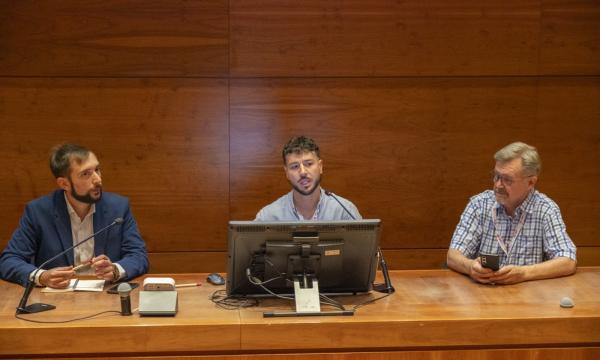
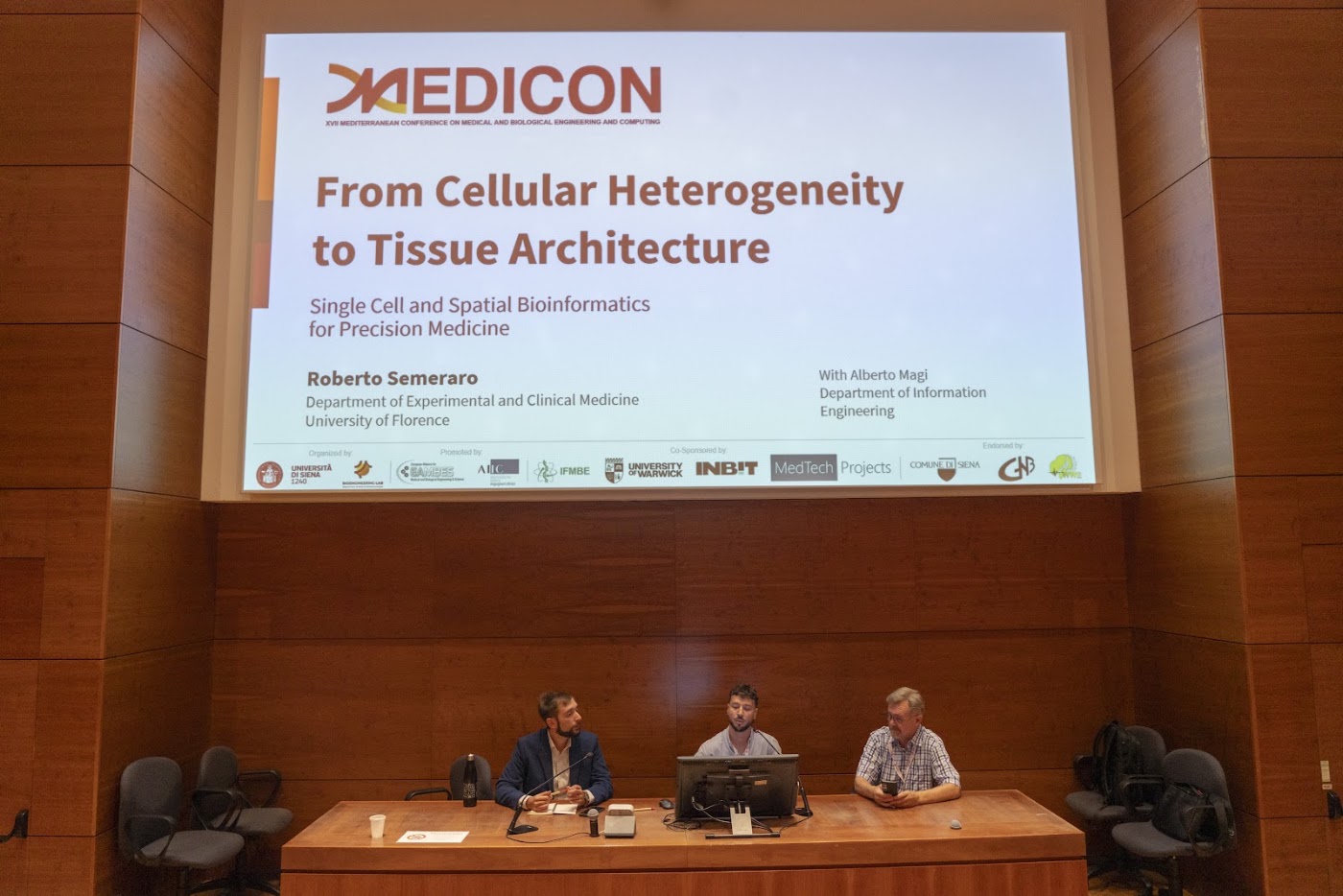
On September 17, Roberto Semeraro, from the University of Florence, delivered a talk in the Aula Magna Cardini at Presidio Mattioli, titled “From Cellular Heterogeneity to Tissue Architecture: Single Cell and Spatial Bioinformatics for Precision Medicine”. His presentation explored how computational approaches help translate complex molecular measurements into a deeper understanding of disease.
The talk began with a central challenge: a molecular signal measured in a patient sample does not necessarily reveal which cells produce it or why it changes. An inflammatory signature, for example, may reflect a greater abundance of immune cells, increased activity within those cells, or both. Single-cell approaches help distinguish these possibilities, while spatial methods reveal where the cells are located and how their tissue environment shapes their behaviour.
Semeraro highlighted the computational steps that make these observations interpretable: identifying technical artefacts, mitigating batch effects while preserving biological variation, reconstructing plausible transitions between cell states, and integrating complementary molecular measurements. He also discussed how regulatory networks and cell–cell communication analyses can generate hypotheses about disease mechanisms, while spatial profiling places these hypotheses within tissue architecture.
The broader message extended beyond any individual technology: biological knowledge and computational modelling depend on one another. Biology defines meaningful questions and provides evidence against which models can be tested; computation reveals relationships within complex data and helps identify the next experiments to perform.
This continuous exchange lies at the heart of bioengineering. For precision medicine, its value is in connecting molecular measurements to disease mechanisms and developing better hypotheses about diagnosis and intervention. Keeping biology, computation and experimentation closely connected is essential to turning richer data into more precise medicine.
The work presented at the conference has also been published as a book chapter in Springer’s IFMBE Proceedings series, which brings together contributions in medical and biological engineering.